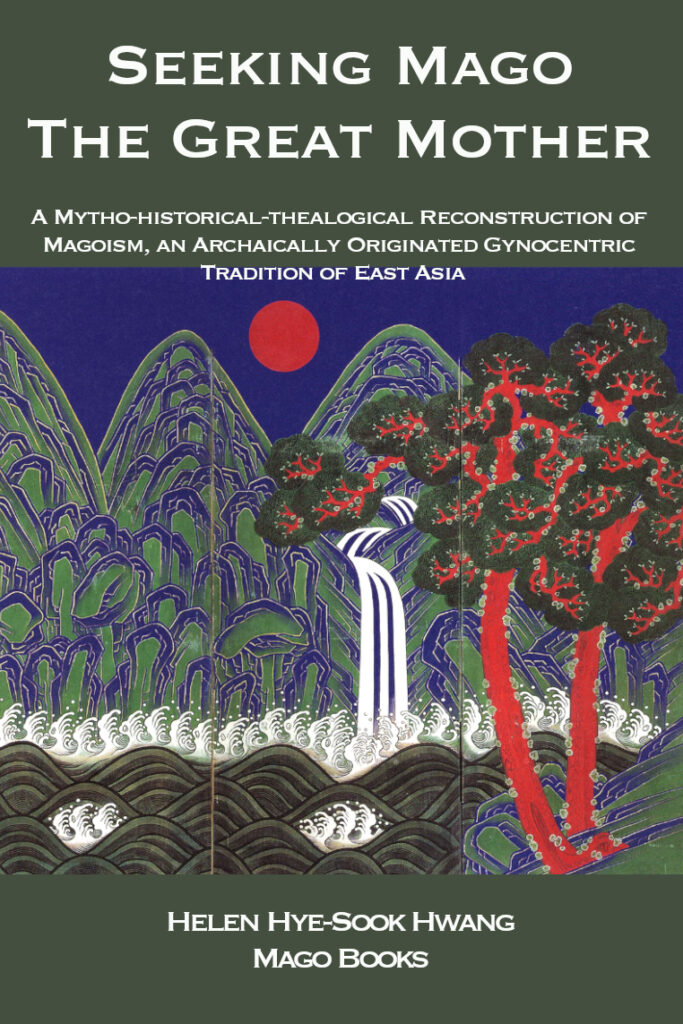
Title: Seeking Mago, the Great Mother from Old Korea: A Mytho-Historical-Thealogical Reconstruction of Magoism, an Archaically Originated Gynocentric Tradition of East Asia
Forthcoming September 2026
E-Book: 10.00 (Pre-order)
Paperback Book: 28.00 (Pre-order)
ISBN: 9798187895434
Trim Size: 6×9
Total page: about 430
Author: Helen Hye-Sook Hwang
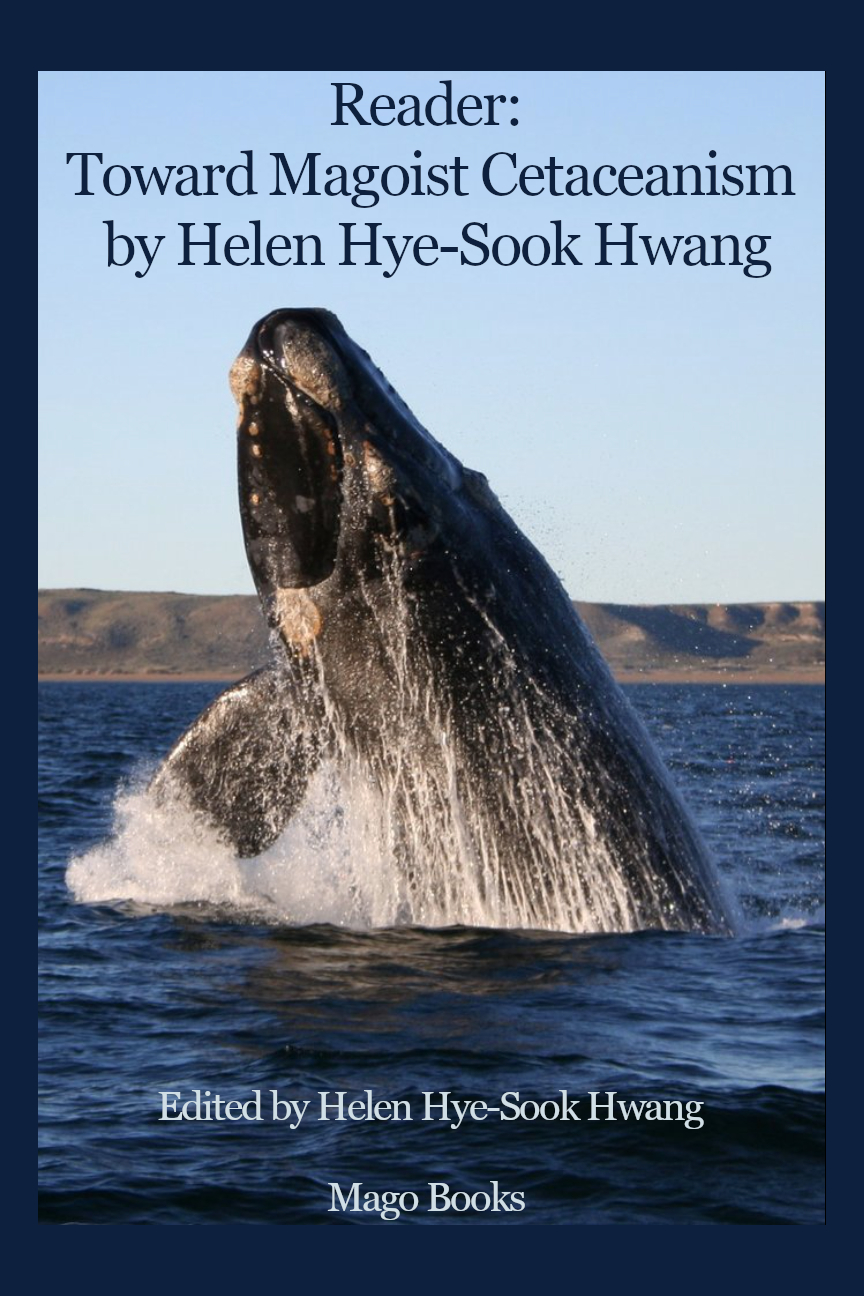
Description: This book is a slightly modified version of my doctoral dissertation written in the early 2000s. This book’s title, Seeking Mago, the Great Mother from Old Korea: A Mytho-Historic-Thealogical Reconstruction of Magoism, an Archaically Originated Gynocentric Tradition of East Asia, differs a bit from the latter, “Seeking Mago, the Great Goddess: A Mytho-Historical-Thealogical Reconstruction of Magoism, an Archaically Originated Gynocentric Tradition of East Asia” (Claremont Graduate University, 2005). “Old Korea” means the pre-patriarchally originated (read pre-Chinese) people and land of the Cosmic Mother who pioneered the Neolithic through the socio-political-soteriological system in the form of matriversal confederacies. It has taken 26 years for me to verify its original structure and premises of Magoism, the Way of Mago, the Creatrix. In fact, my dissertation shows the widest and deepest scope of Ceto-Magoism (the Whale-guided Way of Mago, the Creatrix), a modified notion for Magoism (the Way of Mago, the Creatrix). Old Koreans do NOT represent a national or ethnic identity. They refer to “Matriversalists,” united across borders. They raised Matriversal Civilization (Ceto-Magoist Civilization) that we moderns inherited. This book is indispensable in understanding the foundation of my lifetime research project, Ceto-Magoist Studies better known as Creatrix Studies. I have written books and articles to support, introduce, and verify the premises of Magoism laid out in my dissertation. My books include The Mago Way: Re-discovering Mago, the Great Goddess from East Asia (Mago Books, 2015), Mago Almanac (Mago Books, 2016-Present), and Reader: Toward Magoist Cetaceanism (Mago Books, 2023).
Keywords: Mago, Magoism, Old Korea, East Asia, Creatrix, Cosmic Mother, Goddess, Mythology, History, Religion, Patriarchy
Table of Contents
Acknowledgement
Transliteration Notes
Table of Maps
Table of Figures
Preface
Part I: Preliminary Discussions
Chapter 1
The Method of a Magoist Mytho-Historic-Thealogy
Chapter 2
Primary Sources, History, and Nationalism
Chapter 3
Feminist Readings of the Magoist Texts, the Budoji (Epic of the Emblem City) and the Handan Gogi (Archaic Histories ofHan and Dan)
Part II: The Budoji and The Handan Gogi
Chapter 4
Female Principle in the Magoist Cosmogony
Chapter 5
Incipient Developments of Magoism
Chapter 6
The Flowering of Magoism in the Archaic Confederacies of Magoist States, Hanguk and Danguk
Part III: Various Sources from Korea and China
Chapter 8
Magoist Mythic Tales from Korea
Chapter 9
Ritual Practices of Magoism from Korea
Chapter 10
Magoism in Early Chinese Texts
Chapter 11
Magoist Women from Chinese Sources
Conclusion
Appendix
Bibliography
Beginning Pages: TBA



Comments are closed